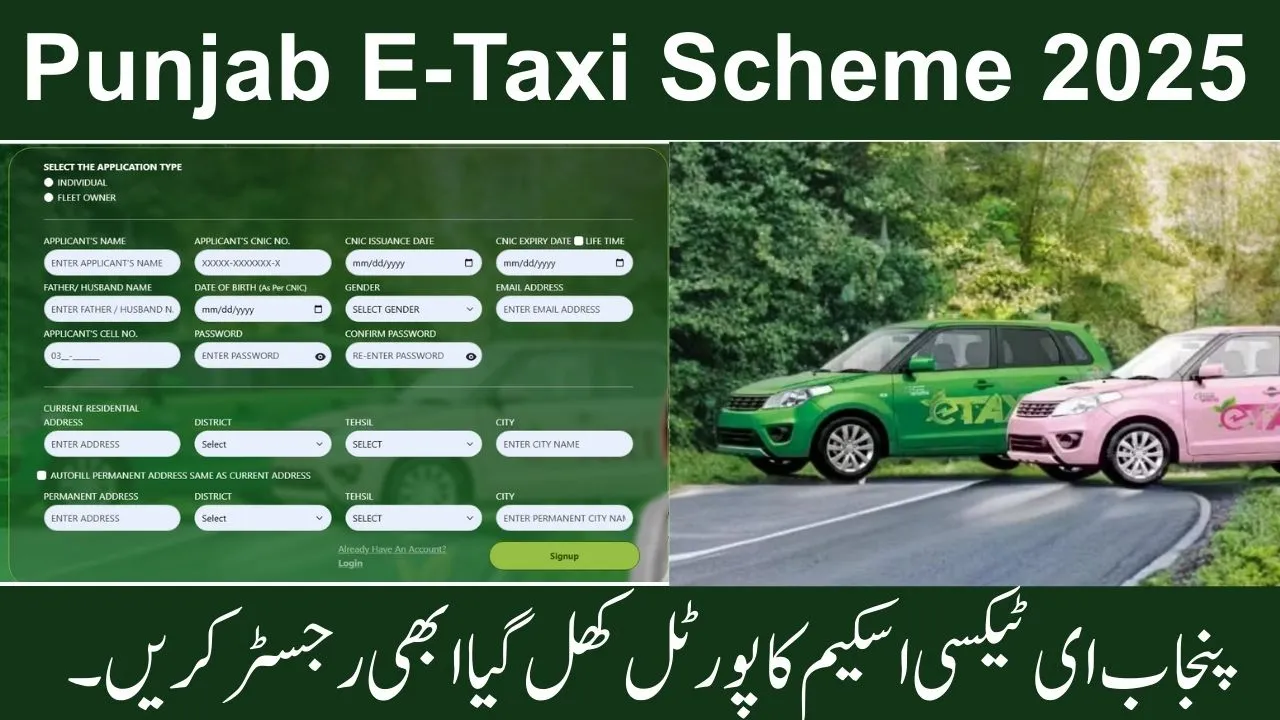
CM Punjab Green E-Taxi Scheme 2025
Punjab’s push toward cleaner mobility isn’t just about vehicles; it’s an ecosystem move. The CM Punjab Green E-Taxi Scheme 2025, led by Maryam Nawaz, blends interest-free loans, easy monthly installments, and city-ready technology like GPS and ride-hailing compatibility with platforms such as Uber and Careem. In Phase 1, 1,100 units—a mix of 100% electric and hybrid taxis—are slated for Lahore, Faisalabad, Multan, and Rawalpindi. From a policy analysis standpoint, this kind of design lowers barriers for first-time drivers, aligns incentives for green entrepreneurship, and strengthens the EV ecosystem through demand certainty.
A standout feature is infrastructure distribution. With charging stations every 3 kilometers in core corridors, the plan attacks range anxiety head-on. Vehicle choices such as Honri VC20 and Honri VC30, each within a 200–300 KM range, are locally assembled, easing parts and service workflows. For affordability, price bands like PKR 4 million to PKR 5 million pair with monthly payments PKR 8,000–10,000, softening entry for new earners.
Who Can Participate
- People With age 21 to 55
- Permanent resident of Punjab
- Have a valid driving license
- Clean record
- A public transport services commitment
Required Documents
- Passport-size photo
- Driving license copy
- Proof of residence
- Bank statement last 6 months
How The Scheme Stimulates The Economy
- Catalyzes create jobs and more stable income through predictable fares.
- Matures the EV ecosystem with maintenance pipelines and charging uptime.
- Encourages green entrepreneurship—owner-operator models that scale.
Notably, public response has been robust, with 60,000+ applications indicated across waves. Operationally, plans mention Charging Infrastructure 250+ stations in Lahore, a strong baseline aided by driver training, partnerships like Dewan Motors, and a public awareness campaign to build trust.
Practical Tips
- Apply early, double-check correct CNIC, and keep a clean driving history.
- Secure a permanent license if you currently rely on a learner’s permit.
Keep Digital Documents Ready For Rapid Processing
It speeds the verification call, loan paperwork, and vehicle allocation, followed by a driver training session and ride-hailing platforms access.
Application Portal Opened for Punjab E-Taxi Scheme
The policy headline—Punjab government launching the E-Taxi Scheme under Transport Vision 2030—speaks to measurable environmental and economic gains. The pivot to eco-friendly, affordable transport is anchored in a first batch of 1,100 electric taxis and an online flow via online forms at e-taxi.punjab.gov.pk (with earlier windows like October 5, 2025). Framing benefits in practical terms, the plan targets air pollution reduction, fuel cost savings, modern travel facilities, and mobility equity through employment opportunities and better urban mobility.
E Taxi Portal For Registration
The financial stack is central. A financing arrangement for electric vehicles leverages participating banks, with the Chief Minister direction enabling loans up to Rs. 6.5 million. Mechanics include a subsidized down payment, where the government covers interest—bringing price points such as EV price Rs. 4 million and EV price Rs. 10 million into reach. There’s even a Punjab contribution Rs. 585,000 toward down payments via partner banks. Public comms previously timestamped releases (Published Sep 16, 2025, 6:10 pm) and bylines like Arsalan Khattak, which reinforced transparency during rollouts.
From an implementation lens, coordinated underwriting and processing yield shorter cycle times and reduce informality risk. When drivers have predictable monthly payments PKR 8,000–10,000 (in electric lines) and structured guidance, they’re better positioned to achieve on-time repayments and asset maintenance.
CM Punjab E-Taxi Scheme 2025 — Pilot Design, Allocations, and Institutional Railings
The CM Punjab E-Taxi Scheme 2025 opens with a pilot project of 1,100 e-taxis on interest-free instalments, timed around official launch in August 2025. Digitally, the Punjab Information Technology Board (PITB) is responsible for the online portal, streamlining applicant intake and validation. Equity measures embed a 30 e-taxis reserved for women allocation, while supply capacity is diversified through nine companies shortlisted.
On the fiscal side, incentives reduce friction: the government pays markup, token tax, and registration fees. Operational backbone includes solar-powered charging stations and hub-and-spoke service centres to keep vehicles roadworthy. The eligibility policy to follow keeps space for fine-tuning, but the baseline points to Punjab residents holding valid CNIC and valid driving licence—including route-specific endorsements like LTV or PSV where needed.
Allocation logic and market structure
- Socio-Economic Targeting: Unemployed youth priority and women drivers priority.
- Portfolio Channels: Feet owners eligible and ride-hailing companies eligible for bulk allotments.
- Pilot Math: Pilot allocations 1,000 fleet, minimum 10 vehicles each, with 100 taxis for individuals and 30 for women—balancing institutional capacity with single-owner opportunity.
Vehicle specifications—Honri VC series with an estimated range 200–300 km—fit city dwell times and charger spacing. Early density is set by Lahore initial charging, with province-wide expansion staged as capacity scales.
Compliance and onboarding flow
- Corporate applicants bring SECP, NTN, and company documents.
- Digital Steps: account creation, select individual or fleet, interest-free plan selection, review monthly payments, and submit applications.
- Back-Office: Eligibility checks, offer letter, vehicle delivery timelines, and driver training with induction details.
Risk controls that matter in practice
- Dedicated portals (transport.punjab.gov.pk, e-taxi.punjab.gov.pk) reduce leakage and standardize evidence checks.
- The combination of government covers interest and government pays markup narrows default probability by front-loading affordability.
- Capacity pathways—driver training, service centres, and predictable charging stations every 3 kilometers—limit downtime and protect asset quality.
Field-Level Considerations for Drivers and Fleets
Even with strong incentives, operations decide outcomes. For drivers, preserving a clean record and clean driving history influences allocation decisions and platform earnings. Converting a learner’s permit into a permanent license is more than compliant paperwork; it shortens the path to activation on ride-hailing platforms access.
For fleets, dispatch and utilization are the margins. Matching routes to Lahore initial charging nodes and planning for province-wide expansion enables higher asset turns. Vehicles such as Honri VC20, Honri VC30, and the broader Honri VC series respond well to regular preventative checks—tied to service centres and supplier networks like Dewan Motors where relevant. Keeping digital documents ready also accelerates renewals, finance audits, and eligibility checks.
From a systems perspective, aligning bulk allotments with depot-level chargers (including solar-powered charging stations) can stabilize energy costs. For independent owner-operators, watch cashflow: bucket earnings into fixed monthly payments PKR 8,000–10,000, energy, maintenance, and savings. When partner banks and participating banks expect predictable repayment behaviors, access to top-up capital and future upgrades becomes smoother.
Conclusion
The Punjab E-Taxi Scheme shows how a big public idea can turn into everyday benefits: cleaner air, lower running costs, and real jobs. Led by Maryam Nawaz under Transport Vision 2030, it couples policy with practical rails—interest-free loans, a government covers interest model through partner banks, and support like the Punjab contribution Rs. 585,000 on eligible down payments. That financial backbone brings electric mobility within reach for unemployed youth, women drivers, and small operators who have long been priced out. On the ground, the plan’s first wave—1,100 e-taxis including the Honri VC series—connects with dependable operations: charging stations every 3 kilometers beginning in Lahore and targeting province-wide expansion, vendor-backed service centres, and structured driver training. Just as importantly, integration with ride-hailing platforms turns those vehicles into steady income engines rather than parked assets. The allocation logic—mixing individual ownership with fleet participation—helps balance scale, uptime, and service coverage, while reserved slots for women widen access and improve safety choices for passengers. Documentation flows, verification calls, and onboarding are not glamorous, but they reduce friction, standardize quality, and keep repayments predictable against loans up to Rs. 6.5 million. I see a strategy that does three things at once: builds demand for EVs, de-risks adoption with public support, and seeds a local skills market for charging, maintenance, and fleet management. If the state keeps its promises on infrastructure, timely disbursals, and transparent portal workflows, the scheme can become a repeatable template for other provinces. Success will come from small daily wins—drivers hitting targets, chargers working on time, and agencies publishing clear, current timelines. With those basics in place, the E-Taxi Scheme is not just a pilot—it is a scalable path to cleaner streets and broader livelihood options in Punjab.
FAQs
What is the CM Punjab Green E-Taxi Scheme?
A provincial program enabling residents to obtain electric or hybrid taxis on interest-free financing, pairing vehicle allocations with training, charging infrastructure, and ride-hailing compatibility to expand clean transport and create youth employment.
Who can apply?
Punjab residents aged roughly 21–55 with a valid CNIC and driving licence (LTV/PSV preferred for taxi use). Women, differently-abled applicants, unemployed youth, and qualified fleet operators can be prioritized under defined quotas and pilot allocations.
How do I apply online?
Create an account on the official portal, enter personal and driving details, upload documents (photo, licence, CNIC, proof of residence, bank statement), choose an individual or fleet, pick the interest-free plan, review installments, and submit for verification.
What vehicles are expected?
Locally assembled EVs such as Honri VC series (examples VC20/VC30) with about 200–300 km range, GPS, and ride-hailing readiness. Specifications and suppliers may vary by lot, subject to government shortlists and contract awards.
What costs does the government cover?
Markup/interest on approved loans, plus taxes/fees in some phases (e.g., token tax, registration). Down-payment support may apply via a fixed provincial contribution, while applicants repay principal through monthly installments.
Are there allocations for women?
Yes. Pilot phases typically reserve a defined number of e-taxis for women drivers and include training measures to support safe, sustainable participation in the sector.
How is charging handled?
Initial density in Lahore expands province-wide, combining grid and solar-supported stations. Planning targets short gaps between chargers to reduce range anxiety and keep fleet uptime high.
What happens after selection?
Verification call, loan paperwork, offer letter, vehicle handover, and required training/induction. Drivers then activate on approved platforms and begin operations under compliance and maintenance schedules. Support centres assist with parts and service. Periodic eligibility checks may apply.